Autodidact: self-taught

May
28
2014

The Aeonian Academy

by V. L. Craven
Athena

Athena, Parthenon, Athens, Interior Model, Metropolitan Museum of Art

I have begun writing a novel that will be absorbing much of my time. It has it’s own blog: The Aeonian Academy , which focuses on art, classics, mythology (chiefly Greco-Roman & Egyptian), nature and literature.

The site is more about being part of the world of the characters-it’s 99% images-than about the process of writing. I’ve always found it useful to immerse myself in the world of my books and that site is an excellent way to do so. The characters’ world is one of beauty and books (and tea) and so that is what you’ll find there. I hope you’ll consider joining us.

I will still post here, but posts will be sporadic and will no longer automatically be concerned solely with the macabre.

May
05
2014

Great Minds Blog Tour

by V. L. Craven

I have been invited by Michael Hibbard to join in the Great Minds blog tour of writer/bloggers. And thank you, Mr Hibbard for the kind words.

Before I answer the questions before me, I should like to tag Mr Paddy Kelly , author of Erotic Refugees. I’ve recently finished reading his latest manuscript that is, frankly, incredible-it will appeal hugely to fans of Neil Gaiman. It has that YA/adult cross-over appeal, as well. Very inventive and wonderful. We just need to find the man a publisher. He’ll be the next stop on the Great Mind’s blog tour, so be sure to check out his blog next Monday.

On to the questions:

1. What am I working on?

Just last week I started making notes for a novel about an woman who is invited to join a centuries-old intellectual organisation for people who do not excel at learning in a structured environment but who are encouraged to pursue their interests as fervently as they wish. But there are always prices to pay for getting what you most wish for.


2. How does my work differ from others of its genre?

I’m not sure I would say that it does-much of my writing is literary fiction along the lines of Patricia Highsmith. Where normal people appear to be going about their lives but things aren’t always what they seem. Or they’re pushed to the point of behaving like animals, which I think all people are capable of. The trick is to get the reader to identify with the characters completely throughout the situation to see how they would behave similarly. Very rarely do I write characters who start out evil, which is popular in media-people like black and white characters.

3. Why do I write what I do?

I’ve always had lots of things going on in my head-conversations, ideas, places, characters. I often write to play with those things-to see if I can make characters fit together. Or, like this novel I’m about to begin, it has several characters from different stories that either didn’t quite work or I didn’t start yet and it has two different organisations I’ve had ideas about for years. Suddenly, very recently, all of these things have coalesced and it’s so obvious they belong together. I feel like I’m about to bring all of these people into a room and have them do a read-through together like a play.

4. How does my writing process work?

Carrying on from the previous question, I think about characters and situations a great deal-whatever presents itself-but I’ve always had loads of imaginary friends. So I live with all of these invisible people talking around me and I listen to them and get to know them and eventually I’ll have an idea for a story they could be involved in. It always starts with the characters.

I make notes about plot, and characters-physical attributes and such. Then when I start writing I often write dialogue first, because my characters talk a lot. I write it like a play. Character One: whatever they say. Character Two: response, etc. Then I fill in their actions during the conversation. And work outward from there to descriptions and those sorts of things.

This particular novel is going to be interesting because it’s going to have a bunch of characters I’ve known for years but who’ve never ‘met’ each other. I did theatre for years growing up so writing has often felt like directing an improv group. I don’t tell them what to say or what to do-I just say, ‘This is where we’re starting and this is what needs to have happened by the end of the scene.’ And see what they do.

I suppose in response to the previous question-I write because I want to see what my characters are going to do. Readers probably think writers know exactly what’s going to happen, and writers do, to some degree, but I don’t know how these people, who are very much fully-formed people to me, are going to go about it. Or what is going to come out of their mouths.

Jul
19
2013

Freelancing and Notes from the Past

by V. L. Craven

As my regular readers know, Friday is book review day, but I’m currently wrestling with the side effects of some new medication-mainly the fact that my eyes want to be closed all the time-and launching a comic with my husband. Which is semi-autobiographical and very fun. Writing a comic is far more difficult than I would have ever thought.

Speaking of writing, I’m also starting to freelance. So if you have writing that needs doing and would like to give me filthy lucre for doing so, please see my author site for info or email me at my freelance email .

VLCraven.com Header

See how classy? Because I am classy & will write classy things for you. Or not. Your call.

For the above reasons, this week’s book review is notes from a previous blog that is no longer easy to find on the internet. The notes are still relevant, as books worth reading are still books worth reading. The original post date was September 27, 2006.

Here we go:

Art of Murder I’ve finished The Art of Murder , which held my interest, but felt a bit forced at the end. I’m a notorious end-niggler (it’s not as dirty as it sounds) so it’s probably just me. If you enjoyed Never Let Me Go I highly recommend this, which I’ve recently discovered is called speculative fiction. Making History by Stephen Fry is another (excellent) example of this type. If you have read any of these three you should try the others.

In classic fashion, I picked up a book fresh out of the Baker and Taylor box (rather than one of the, you know, thousand or so I have at home I haven’t read). It’s Al Franken’s The Truth (with Jokes) which is exactly what I thought it would be: amusing, infuriating and depressing. I usually don’t read current event/political books because politics annoy/bore me–it’s amazing how something can be simultaneously boring as hell and annoying as shit, no?–but I do enjoy Mr Franken’s dry wit. I figured something amusing would keep me reading.

Meaning of Night cover And I’ve hit a wall. Every reader goes through it. Nothing compels you. It’s frustrating, I must say. Bizarrely, I’m just not in the mood for Victorian fiction so I’ve set aside The Meaning of Night because I’m tired of feeling guilty for not reading it. I’m no longer going to feel guilty, because it’s just not the right time for me. We’re in different places, you know? We should take some time off and maybe try again later… It really isn’t you, you’re like The Alienist , which I loved, you have all sorts of things I like about Victorian fiction, your pages even feel nice. For whatever reason, it simply isn’t happening for me right now. I’m truly sorry. Don’t give up on me.

End of post.

Clearly, I recovered from my reading slump, thank goodness, or this blog would have never been created. Next week, I promise a new book review if I have to sell my soul to the devil to make it happen.

I also dedicate all the work I’ve done today to Trader Joe’s Dark Chocolate Covered Espresso Beans. I’ve accomplished quite a bit today and it’s about 35% love of writing and 65% these babies .

May
15
2013

Hatching Reptiles & Writing

by V. L. Craven

I took a little unscheduled break due to a few things.

First: my dog had an episode of vestibular syndrome , which is vertigo. It’s scary to watch and it can look like a stroke but it’s highly treatable and goes away and probably won’t return. Sometimes people put down their dogs because they think it’s a stroke when it’s something that would resolve in a few days or a week. Please tell any dog owners you know about vestibular syndrome. Dogs are great. This one is mine:

Emma the Best Dog Ever

75% Chow, 25% Shar-Pei; All AWESOME

Next, very happily, I started writing again. There will be an entire post about that next Wednesday. Short version: when you have loads of ideas for stories, you have to write down all of those ideas at that time because if you ignore them, they get stroppy and they will go away.

Screw You Guys Penguin

Like so

Unfortunately, there’s only so much time in a day and writing other things doesn’t leave an enormous amount of time to write blog stuff, because I don’t want to just poop out blog posts. I do actually care about what I post here, believe it or not.

Then: My migraines decided to have a passel of their friends (headaches) over for parties every day, all day. Several days a week of nauseated headaches and migraines makes for a fun existence, let me tell you. It’s like having a reptile trying to hatch its way out of your skull, but it doesn’t have a beak, so it can’t just crack your skull open and be done with it (at a certain point, you’d be fine with that) so it just pushes and pushes and turns you into an Existentialist. I mean, really, does life have a point? We really are just put here to fritter away and die, right?

This went on for many weeks, as I hate going to the doctor (I always feel like I’m wasting their time and whatever it is will resolve itself on its own). But a person can only take so much Sumatriptin and being unproductive due to waking up with a headache and deciding to simply not get out of bed that day, if THAT’S what it was going to be like.

Went to the doctor, got Topamax. Or, as people who take it call it, Dopamax, because wow.

COMPLETELY AWAKE

I’M NOT FALLING ASLEEP! I DON’T KNOW WHAT YOU MEAN!

That seems to have lessened, thankfully. I mean, I’m sitting upright and typing without having my husband holding my eyes open. One of the other side effects is appetite suppression, so hopefully that will work out.

In there I took a couple of days to do jury duty for the first time which was an interesting experience. I wasn’t chosen, which was a bummer, but maybe next time.

And finally, I’ve upgraded my Ubuntu machine to 13.04 and now my wireless doesn’t work and I just…don’t feel like dealing with it. So I’m on my Windows machine for the time being. The good bit is I’m surrounded by my macabre geeky office stuff, the bad news is this Windows computer is effing slow and this chair does bad things to my back. Whinge, whine, moan, complain, first world problems, first world problems.

But I’m back!

Mar
27
2013

Writers and Their Imaginary Friends

by V. L. Craven
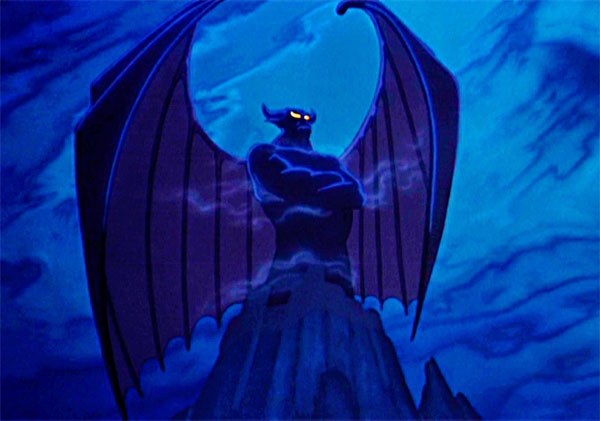
Chernabog from Fantasia

Chernabog is *my* imaginary friend.

After I wrote my first novel I worried I’d never have anything else to write about again; everything I felt/thought/knew was in that thing (it was 2,400 pages long-I felt and thought a LOT).

What I hadn’t taken into account was that my brain would continue to invent imaginary friends for me to talk to/think about who would get themselves into interesting situations.

I also subscribed to the belief that novels were the only form of ‘real’ writing and short stories were lazy. HA! I laugh at that person. Younger Self, you were so very wrong.

Now that I’ve become more interested in and appreciative of short fiction, I have a load of ideas and will be working on those in the coming weeks, which will very likely cut into blogging time. I’ll still be doing posts, but Sunday Science & Tech posts and Monday Links posts will be put on hold for the most part. Thursday’s Film/TV posts will happen when they happen, as will Wednesday free-for-all posts. Hopefully Friday Book Reviews, Saturday Media and Tuesday Images/Art will be unchanged.

I’ll still be posting regularly, but it won’t be nearly seven days a week.

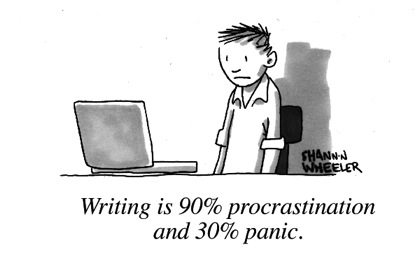
Writing=panic

And 120% being crap at maths

Onto the second part of the post: Other writers and their imaginary friends.

In general, I’m not crazy about listening to writers talk about what they’re working on. It’s like listening to someone talk about the dream they had last night. Nor do I feel comfortable talking about my own fiction (though I’m very enthusiastic about it) because I feel like I’m nattering. ‘You had to be there, but you couldn’t be because it’s in my head.’ Writers talking about their current projects are like schizophrenics talking away about people that never existed and things that never happened as though it were all true. The other person just nods and hmms and waits to be able to talk about actual things the rest of the world deals with.

So the only thing I’ll say is that the stories are either weird/horror fiction, which is a new genre to me, or very dark comedy, which is typical.

Rather than boring you with my inner, non-existent friends, I’d prefer you just read some of my writing. My husband and I have a new site called PentaPrompted , where we have one hour to write a story (me) or draw a picture (my husband, K) using the five words we get from a nice app called Idea Factory Free . It’s very fun and has also spurred some ideas for stories. Everything you see on the site is unedited but great fun to do. Check it out and let us know what you think.

Feb
28
2013

Depression, Misogyny and Albus Dumbledore

by V. L. Craven

People like being bummed. It’s the only guess I have for why my really depressing posts get the most traffic. That can’t be right, though…

Anyway, I’ve been reading more of the Cerebus series by Dave Sim. I’ve done Church and State I & II , Melmoth , and Flights . I’ve also given myself something of a coronary in reading he’s diatribe about feminism, homosexuality and race tangents

Well, the first two parts of it. I had to take a break there. If you get through all of it, let me know what you think.

I’m enjoying Cerebus on the whole and I agree with Sim on some of his assertions about certain portions of feminism (I just wish he wouldn’t paint all women with the same brush). And I find that RS Stephen sums up how I feel much better than I do in her essay “Masculinity’s Last Hope, or, Creepily Paranoid Misogynist”. This bit in particular: “Despite the fact that you champion reason, your writing lacks the factual and intellectual rigor required by even an undergrad English essay, and your arguments aren’t all that logical.”

Melmoth is in interlude about Oscar Wilde, of all people, and is incredibly well-rendered.

As the storyline of Cerebus goes along it gets more complex and interesting, which is only to be expected, and even knowing that he and I wouldn’t be able to have an intellectual discussion over dinner doesn’t ruin that, though it does alter my reading of the text somewhat. It’s a train wreck situation. Where you wish you didn’t know it existed, but once you do, you just have to look. I simply had to know how he felt about women. So I read Tangents. And it altered the way I read his work.

This brings me to something else that’s in the literary news lately–J.K. Rowling commenting off-handedly that Dumbledore is gay. (If you don’t know who J.K. Rowling or Dumbledore are, please return to your rock for the rest of this post.)

Since she outed him there’s been several sides to the conversation. The two most predictable are: ‘What a big pedo! That’s why he liked Harry so much!’ and ‘She should have said it explicitly, Dumbledore was in the closet!!!’


Does knowing he was always gay change the way a person would read the books now? It shouldn’t, as it has no bearing on the majority of the books. But it will to some people. The people who only see the word ‘gay’, no matter if it’s in front of “the gay man who cured cancer”. In The Celluloid Closet Quentin Crisp said, “When you say heterosexual, people focus on the ‘hetero’ but when you say, ‘homosexual’, people focus on the sex.”

I’m a lesbian and a writer and I fully understand why Rowling handled the character as she did. A writer knows all sorts of things about her characters that she doesn’t tell the audience because it’s not pertinent to the story. It wouldn’t have made one bit of difference if Albus (I can call him that because we ride the same bus) had been explicitly gay or not. Who he loved didn’t matter much in terms of the story. And in a kids’ book, what is he supposed to say? If Rowling wanted to be sure everyone knew, at what point was Albus supposed to say he wanted to make the buttsecks with Grindelwald? You don’t address sex in kids’ books in that way. He said he loved Grindelwald. How much more do you want?

At the same time, she handled it beautifully. She said (when the revelation occurred in Carnagie Hall in New York) that if she’d known it would’ve made everyone so happy she would have told them sooner. The way to de-demonize homosexuality is to let people like the gay person first and then say, “Ta-da! I was a big ol’ queer the whole time!” It’s like Suzanne Westenhoefer, a marginally known but always out, lesbian comedienne and Ellen DeGeneres, a closeted until popular comedienne. Now she’s everywhere with her partner and people are cool with it. Sometimes you have to sneak under the radar before you can throw off the invisibility cloak.

[This post is from a previous blog. Original post date: 24 October 2007]
Feb
13
2013

SEOs, Link Rot, and Breadcrumbs

by V. L. Craven

One of my goals for this year is to improve my blog-in terms of hits and subscribers and such and, to that end, I asked the proprietress of a blog I quite enjoy, Upon a Midnight Dreary , Dahlia Jane, for advice. She asked what I knew about SEOs.

My response: I know what it stands for.

SEO by Yoast

So I looked into plugins and came across WordPress SEO by Yoast, which, aside from having a staggering number of options to tweak to your geeky heart’s desire, comes with an extremely useful guide . The guide can be used by anyone wishing to improve their site or learn about SEOs, but it would work best with the plugin.

In the process of optimising TAitA, I’ve been learning about such exciting things as link rot and breadcrumbs . [‘Link rot’ sounds like a euphemism for problems with your willy, which makes me laugh. But I digress.]

The first thing I’ve done is acquired the domain for theautodidactintheattic.com, rather than including my personal domain in the address. Hopefully, this won’t mess up too very much, as WordPress are supposed to be good about re-routing and that sort of thing. If you have problems with the site, please contact me through the contact form at the top of the left sidebar or comment on the offending post or page.

RSS subscribers prior to last Friday will need to resubscribe. I’ve put the RSS link at the top of the right sidebar. However, if you’re using bloody Chrome and click on that link, you get the XML file rather than the option to subscribe through various services the way you do with Firefox and (probably) IE. This is a rather WTF since Google (the entity that owns Chrome) has an RSS reader. [ This Chrome extension allows one-click subscribing to RSS feeds.]

copyright Southworth--Ugly Hill

From Ugly Hill by Paul Southworth

I’m learning a lot, and also having loads of, ‘What does that mean…why is it important’ moments. Discovering that there are loads of hidden rules of the Internet reminds me of this bit from Black Books:

Start at 7.00

‘The Internet is a game. It has rules. And you need to learn those rules because it’s not a game.’

If you have a WordPress blog and use plugins, please leave a recommendation in the comments. Or if you have any recommendations to improving hit-count and subscribers, your comments would also be appreciated.

Jan
09
2013

Time Wasting and Toilet Paper

by V. L. Craven

I am a book snob. More so than other types of media, as reading a book is a commitment in time and requires more mental effort than listening to music or watching a film/TV. It’s possible to turn off the higher cognitive function of your brain and look at the pretty explosions on the screen for two hours, or ignore the insipid lyrics and dance to the beat for the length of a song.

But reading requires time, comprehension and, at its best, elevates your mind and makes you see the world in a new way.

So when I see someone reading effin Twilight or, God help me, Fifty Shades of Crap , it makes my blood boil.

You’re spending all of that time and energy on something that’s badly written. Reading poorly written prose makes can only damage your own command of the language. The importance of the ability to communicate effectively cannot be stressed enough. It’s the way we find others who share our philosophies and the way we avoid wars.

However, people tend to find faults in others that they possess themselves so when I find something unattractive about another person, I see if that criticism applies to myself.

In this case I must admit that I do things that consume massive quantities of time I’ll never recover, require very little cognitive effort and doesn’t offer improvement as a person. My things are apps on my mobile device. (Hello GetGlue and Curiosity ).

So, read your crap. I promise I won’t roll my eyes in your presence (too much). I even promise I won’t say, ‘Yeah, I waste lots of time doing pointless things, as well.’

And at least when they’re done with wasting their time they have toilet paper. I just have an awesome piece of technology I don’t use to its highest potential.

Dec
19
2012

Playing God

by V. L. Craven

I’m currently working out a new short story (or perhaps novel) idea that involves research. I thought that when I stopped acting I would no longer have to research projects/characters.

Little did I know.

Now when I have an idea for a fiction piece I figure out the background before I figure out the plot. I have to see the world the characters live in long before I see the plot. “This is the world these people live in, what’s the conflict?” That’s how it starts. All fiction (film/TV/play/novel) is about conflict.

I’m working out how the world these people live in operates, which is a full time job. Then I figure out how that world falls apart. That’s how it works for me.

Dec
17
2012

What the Internet Did This Week

by V. L. Craven

If you live in the world, you have to deal with other people. Some of those people are going to be awkward. Fear not! Lifehacker has given us: The Awkward Human Survival Guide , which has tips for coping with people who don’t know what to say/don’t know when to stop saying things/only know how to say the wrong things.

From the Edgar Allan Poe House and Museum FB page:

The Poe Murders is a graphic retelling of many of Edgar Allan Poe’s mystery and horror stories meshed into a single tale. The stories included in this graphic-novel are: The Cask of Amontillado, The Tell-Tale Heart, The Masque of the Red Death, The Purloined Letter, The Fall of the House of Usher, The Raven, as well as others. The graphic-novel will be told in the style of a mystery, in which the characters are searching for the mysterious source causing rational men and women to commit these horrific murders.

They have a limited time to raise the funds necessary; if you’d like to contribute for swell prizes go to their Indiegogo page .

TEDx is the body that licenses people to have TED-style talks in various parts of the world. When it came to the attention of the TED folks that some pseudoscience was making its way into these talks, they issued this letter, which is an excellent introduction to critical thinking. Hat tip to Lifehacker’s article: How to Avoid Bad Science in TED Talks

The Most Common Grammar Gaffes Writers Make and How to Avoid Them . Nothing particularly new on this list, though these are rules that bear repeating. The thing that most WTFd my face was the first line of the article, which was, ‘In 2011, the publisher of my book Enchantment could not fill an order for 500 e-book copies.’ How… ? I mean… Nope, ‘How…?’ is all I have

Speaking of writers, here are some beautiful posters of quotes from famous authors. All of them are elegant, but this is one of my favourites:


Dec
06
2012

Those Krauts Love Books!

by V. L. Craven


Check out this article in the NYT about the state of book selling in Germany

I found this bit particularly of interest: “Last year 94,716 new titles were published in German. In the United States, with a population nearly four times bigger, there were 172,000 titles published in 2005.”

Books can’t be discounted (it’s illegal) and their best-seller lists are filled with literary fiction instead of pop crap.

For the writers out there: they have 14,000 publishers.

How difficult is it to learn German?

[This post is from a previous blog. Original post date: 30 October 2007]

Oct
24
2012

Baudelaire Was a Rather Intense Fellow

by V. L. Craven

Charles Pierre Baudelaire (1821-1867) French poet most well-known for Les Fleurs du Mal (The Flowers of Evil) and the first person to translate Edgar Allan Poe’s work into French.

An aesthete and dandy, he believed (and practised) in the pleasures of the senses. This led him to possibly contract syphilis and gonorrhea. Oh well.

Like Virginia Woolf, he believed art should capture the small, ephemeral moments of life. Unlike Woolf, he was of an impressively cynical mindset and loved him some irony. Though a cynic, he also believed people were fundamentally good. (A view he and I share. They may seem to be diametrically opposed, but, though the world seems harsh and awful, we also believe that it can be better-that man has the capacity to improve and to rise above.)

Similarly to holding seemingly contradictory worldviews, The Flowers of Evil is both grotesque and beautiful with several poems focusing on the putrefaction of the physical body after death whilst carrying on to wax lyrical on the beauty of life. This could be stomach-churning to the faint of disposition, but makes sense in that one can’t fully appreciate life if one isn’t intensely aware of death.

The juxtaposition of death and living life vigorously-and lending a poetic beauty to both-is echoed in Nine Inch Nails lyrics. Reznor’s words can be nauseating but simultaneously truthful and evocative and can express both disgust and a deep affection for a woman, much like Baudelaire. Both have also been reviled by the masses as being immoral and disgusting, but celebrated by those aware of the true nature of existence.

When initially published, Les Fleurs du Mal was receiving well amongst the literary set though several poems were removed prior to publication being deemed obscene (including one about lesbianism). However, most of his work was published after his death.

My favourite thing about Baudelaire is that, when acquainted with Poe’s stories, he felt Poe was expressing thoughts in his own mind that had not fully formed. That feeling of intellectual companionship is something readers most look for, I think. We read to find people of our own views and whims, but who more beautifully articulate those views and whims. We read to find friends without regard to nationality or age. And I’m glad to have found a friend in good old Baudey.

May
24
2012

Book News from Tokyo

by V. L. Craven

[This is a post from a previous blog, with a 2012 update. Original date: 21 January, 2008.]

Novels composed on mobile phones top best-seller lists.

Those kooky Japanese. Not only do they top the world charts for cuteness, but they compose novels on mobile phone text pads. Some novels are then published in hard copy form and some of those reach the best seller lists. Amazing.

2012 Update: I wanted to re-post this one partially because of this bit in the article: ““Will cellphone novels kill ‘the author’?” a famous literary journal, Bungaku-kai, asked…” Clearly, they didn’t.

Whenever something new comes along in publishing, doom-sayers declare it the end of literature. They were saying that when Johannes Gutenberg invented the printing press in the 1440s. Making books widely available would lessen the ‘specialness’ of books and of reading them. Because everyone would be able to do it, no one would.

This is similar to the people that say ebooks will be the end of publishing. There seems to be an assumption that people won’t publish if they’re not going to be paid well. Being a writer means writing whether anyone is going to see your work or not. Very few authors write for a living-they have jobs to pay the bills and anything they receive for writing is a bonus-and so simply having their work published by a legitimate press is worth it. Hell, some people are happy to have their name on the front of a book they paid to have printed and then have to market themselves.

You can’t kill the drive to write and you can’t kill the will of real readers, who will read anything that’s worth reading. I know it’s fun to pronounce the ‘end’ of things since nothing new really happens, but you’re just wasting time you could be spending reading.

Feb
16
2012

Writing is Murder

by V. L. Craven

I’ve begun watching Murder, She Wrote on Netflix. It’s the show that made me want to be a writer when I was small. I asked for a typewriter for my 8th birthday (this was before people were issued computers at birth), and I’d tak away on it, imagining myself as Jessica Fletcher. It was plastic and completely manual, but I loved it. Prior to that, I’d had to write out my plays and stories by hand in an old ledger my mother had given me. Sadly, those stories are lost to time. I can only recall that they were either ghost stories or about treasure or unicorns.

The show reminds me of sort of an American version of Midsomer Murders, but I hadn’t realised what a nosey parker Jessica was. And people, though they initially protest, wind up allowing her to poke her nose in.

For my writer friends-here’s the Murder, She Wrote Original Opening (embedding has been disabled.)

Dec
25
2011

Writers Who Don’t Write

by V. L. Craven

Also known as: Every other person alive.

I cognitively know that most people think writing is easy, but I continue to be amused by people who don’t read and think they can write.

That would explain a lot of what is out there, though.
I worked in independent bookshops for twelve years and lots of people would come in and talk about the book they’d written/wanted to write/had a sliver of a fart of an idea about writing. The last few years they’d come in with the book they’d written and then vanity pressed into existence. Darlings, that’s not a book. (For those interested in a rant about these “authors” see a previous post of mine.)

People who think they’re writers are easy to spot. First, they don’t read very much because they “don’t want to influence” their own writing. With what? Decent grammar? A knowledge of what’s out there so you don’t repeat what someone else has already done? Heaven forfend.

Then, they can’t wait to talk to you about what they’re going to write–they usually haven’t actually written anything…yet. Which means they probably never will. In Pat Walsh’s excellent book 78 Reasons Why Your Book May Never Be Published and 14 Reasons Why it Just Might the first rule is: Your book will never be published because you haven’t written it yet.

I said that to a recent in-his-dreams writer I was cornered by and he said, “Yeah, you have to write at least a couple hundred words before a publisher will look at it.”

Dude.

This person was going to be soon, in the near future, going to be writing a book about his childhood and he obviously knew nothing about the publishing industry. Or reality. You-wish writers are very often not very familiar with reality. They are also quite impressed with their non-existent book. Usually because they don’t read enough to know 8,942 other people have already written the book they may, possibly begin at some point. Perhaps.

The thing that most annoys the holy pete moss out of me is the smugness with which they talk about their fictional fiction. The most recent time this happened, the not-ever-in-a-million-years guy was hinting about his book–trying to get me to ask questions and treat him like an actual author (I suppose so he could practise for his session on Oprah). All before he’d written word one.

I know that there’s far too much emphasis on the marketing of books but when your mack is polished before you’ve figured out the plot of your novel things have got out of hand.

Older Posts »

Powered by WordPress